3.9K
Downloads
22
Episodes
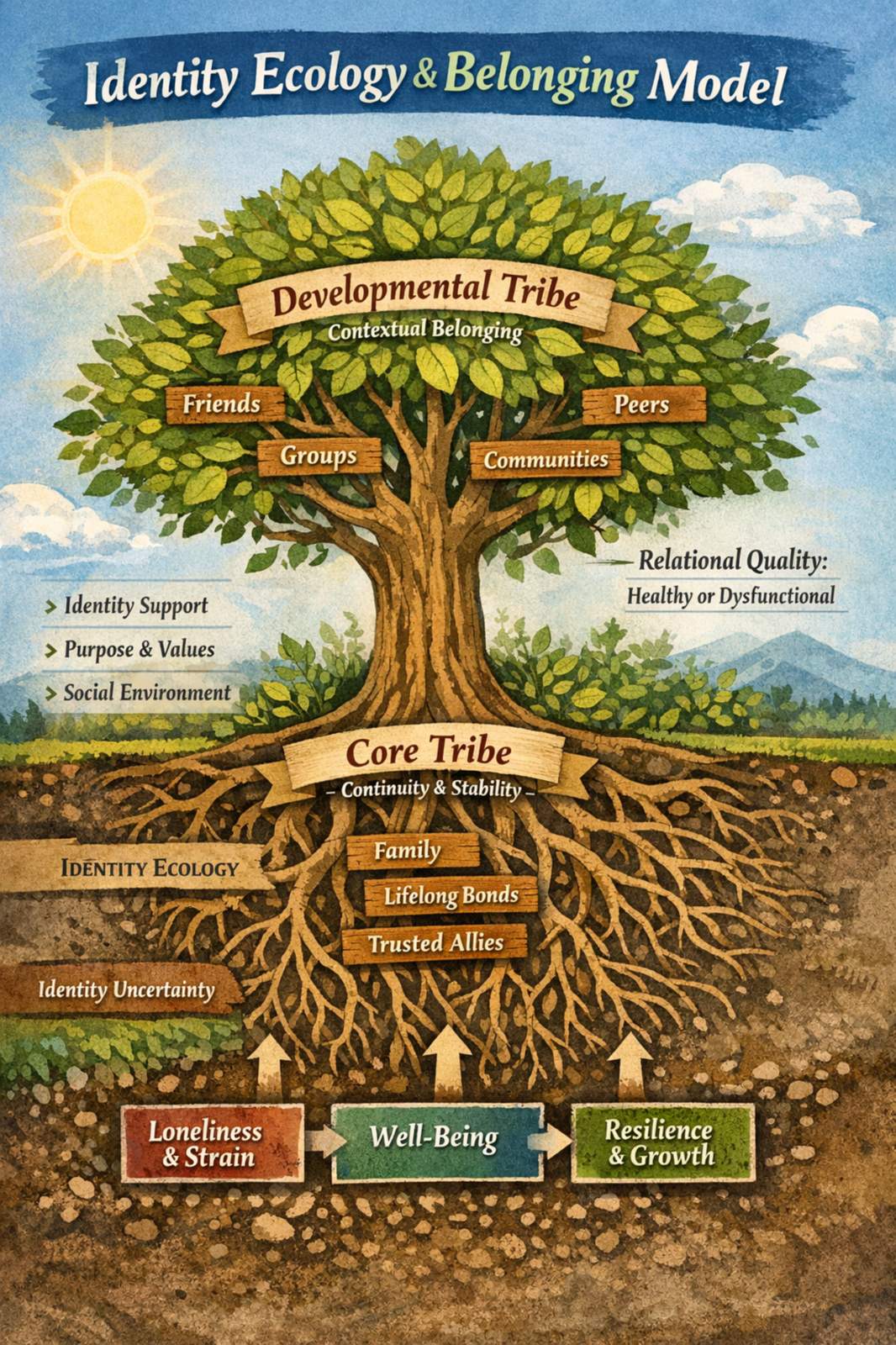
Dr. Curtis Peterson’s Identity Ecology & Belonging Frameworkexplores how human well-being and self-conception are shaped by a complex interplay of social environments and belief systems. The theory posits that individuals rely on relational anchors, categorized as lifelong "core tribes" or situational "developmental tribes," to maintain emotional stability during life transitions. Beyond personal relationships, the framework highlights symbolic anchors like culture and religion, which provide internal structure even when physical social supports are absent. A central innovation of this model is the Belonging Matrix, which distinguishes between the intensity of one's social connections and the actual health or quality of those relationships. By mapping these dynamics, the framework identifies how different belonging profiles—ranging from resilient to maladaptive—impact a person's resilience, loneliness, and overall sense of meaning. Ultimately, this ecological perspective offers a comprehensive method for measuring how integrated social and symbolic networks foster a coherent and stable identity throughout a person's life.
Episodes

Monday May 25, 2026
Monday May 25, 2026
The Deep Dive is based on Dr. Peterson's Lecture on human development which provides a introduction to human growth and development, defining the field as the study of how people change across their entire lifespan. The text highlights a shift from historical theories that capped development at age 18 to a modern understanding that significant growth occurs throughout adulthood. To explain these changes, the sources explore three primary domains: biological, cognitive, and socioemotional processes. Detailed attention is given to foundational theorists, including Sigmund Freud’s psychosexual stages, Jean Piaget’s model of intellectual evolution, and Erik Erikson’s eight-stage psychosocial framework. Collectively, the lectures emphasize that development is a continuous, interactive processinfluenced by environmental demands and social connections. The material concludes that mastering these developmental stages is essential for professionals in healthcare, social services, and education.
No comments yet. Be the first to say something!